Emergency, Legally Required, or Optional? Backup Power Under NEC 700/701/702 and NFPA 110
Emergency and standby power systems supply electricity when normal utility power fails. The National Electrical Code (NFPA 70) classifies them by how essential the load is to life safety — and that classification determines how fast power must return, how the system is wired and separated, and how it's tested. "Backup power" is three different design problems wearing the same coat. What a generator has to power, how fast it has to pick up the load, how long it has to run, and how the system has to be wired all depend on which category the load falls into. Getting that classification right at the start drives the whole design — and getting it wrong is the kind of thing a reviewer catches on a healthcare or assembly project fast.
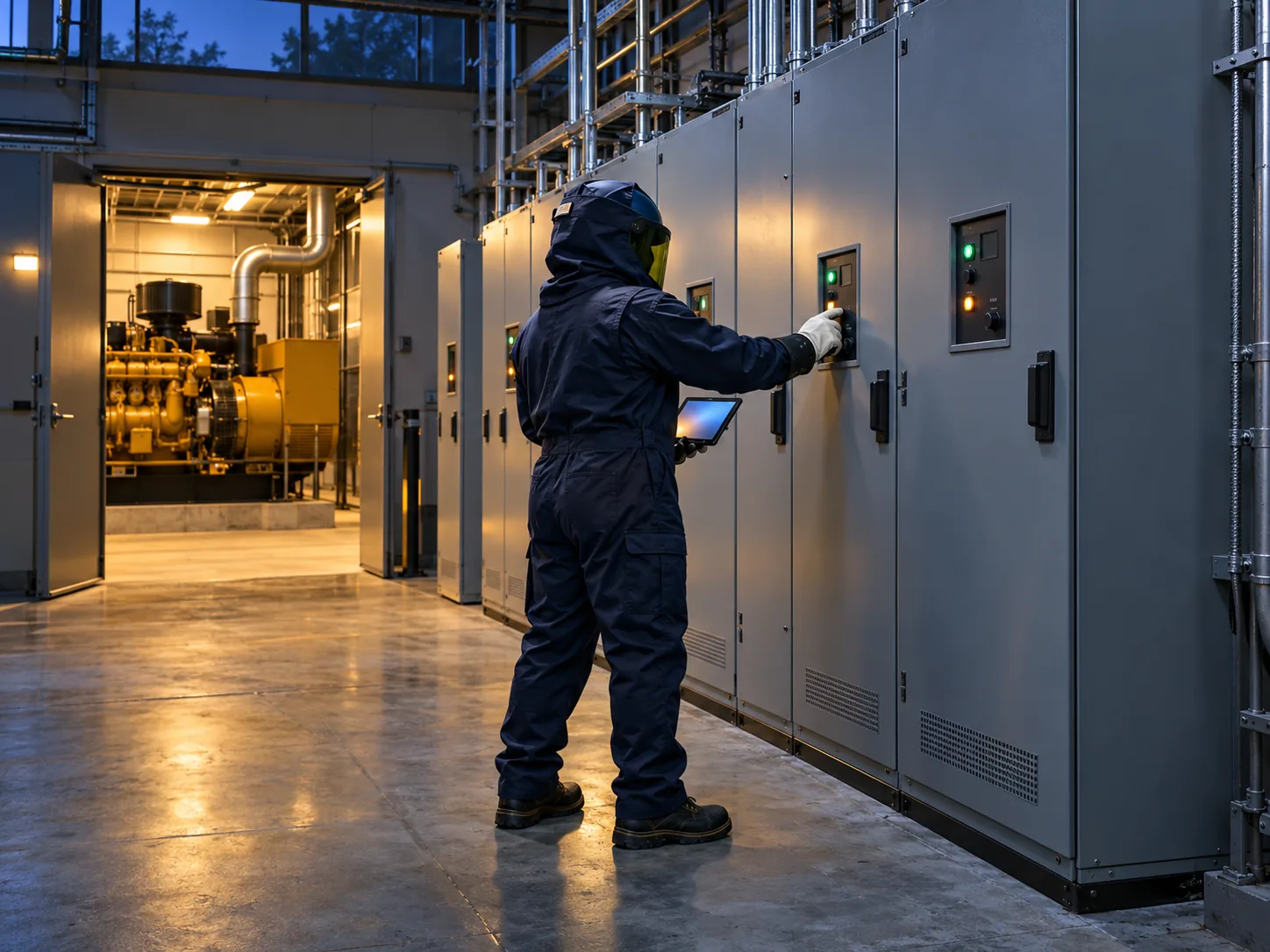
- Sorting each load into the right bucket is a critical early decision; 700 and 701 carry requirements 702 doesn't.
- Article 700 requires power restored within 10 seconds of a normal-power failure; Article 701 allows 60 seconds.
- The NEC requires selective coordination for emergency (700) and legally required standby (701) systems.
The NEC sorts backup power into three categories by life-safety criticality: Emergency (Article 700) — legally required for life safety, power restored within 10 seconds; Legally Required Standby (701) — required by code but not immediate life-safety, within 60 seconds; and Optional Standby (702) — owner-elected, no mandated pickup time. The category drives much of the design.
1. The Three NEC Categories
The NEC sorts backup power by how essential it is to life safety:
Emergency Systems — NEC Article 700. These are the loads legally required to protect life during a power loss — egress lighting, exit signs, fire alarm, and similar. Because lives depend on them, Article 700 requires power to be restored within 10 seconds of a normal-power failure, and it imposes strict wiring, separation, and testing requirements. This is the most demanding category.
Legally Required Standby — NEC Article 701. Loads that a code or authority requires but that aren't immediate life-safety — things like certain smoke-control, some elevators, and systems whose failure could hinder rescue or firefighting. Article 701 allows a longer window: power restored within the time the application requires, up to 60 seconds. Still required, still serious, but a step below emergency.
Optional Standby — NEC Article 702. Backup that no code requires — the owner wants it to avoid financial loss, business interruption, or inconvenience (data continuity, a comfort load, a process). There's no code-mandated pickup time; it's installed at the owner's discretion. Article 702 still has installation rules, but they're lighter than for 700 and 701.
A critical early decision is sorting each load into the right bucket, because 700 and 701 carry wiring and coordination requirements that 702 doesn't (700 also requires strict separation from normal wiring) — and mixing them incorrectly is a code problem.
| Emergency (700) | Legally Required Standby (701) | Optional Standby (702) | |
|---|---|---|---|
| Why it exists | Life safety, legally required | Required by code, not immediate life-safety | Owner choice (no code requirement) |
| Typical loads | Egress lighting, exit signs, fire alarm | Some smoke control, certain elevators, rescue/firefighting aids | Data continuity, comfort, process loads |
| Max restore time | 10 seconds | 60 seconds | No code-mandated time |
| Selective coordination | Required | Required | Not required |
| Wiring separation | Strict, independent of normal wiring | Not required — may share raceways with general wiring | Not required |
2. Where NFPA 110 Comes In
The governing building, fire and healthcare codes and the AHJ decide which loads must be backed up, and in which category; NEC 700/701/702 set the electrical rules for each, including how fast power must return. NFPA 110 — the standard for emergency and standby power systems — describes the performance of the emergency power supply system (the source plus its transfer equipment), using three descriptors:
Type — the maximum time, in seconds, the system can leave the transfer switch's load terminals without acceptable power. Type 10 = 10 seconds, Type 60 = 60 seconds, and so on (with Type U for uninterruptible and Type M for manual). Notice the alignment: a Type 10 system matches the NEC 700 ten-second requirement.
Class — the minimum time, in hours, the system is designed to run at rated load without being refueled or recharged. Class 2 = 2 hours, Class 48 = 48 hours. This drives fuel storage.
Level — the consequence of failure. Level 1 is where failure could cause loss of life or serious injury; Level 2 is less critical to life safety. Note that NFPA 110 itself doesn't map its Levels to specific NEC articles — the authority having jurisdiction (and other codes) makes that call. In practice, Level 1 is typical for NEC 700 emergency systems and Level 2 for NEC 701 legally required standby, although some AHJs, facility standards, and owners require Level 1 for 701 loads as well; optional standby (702) is outside NFPA 110's scope, though an owner can still specify it.
So a life-safety system on a hospital might be specified as, for example, Level 1, Type 10, Class X — where Class X means a runtime other than the tabulated classes, set by the application, the governing code, or the owner (hospitals commonly land on Class X, with the fuel basis coming from NFPA 99 or state rules). The three descriptors together tell the whole story: how critical, how fast, how long.
| Descriptor | What it sets | Example |
|---|---|---|
| Type | Max seconds without acceptable power at the transfer switch's load terminals | Type 10 = 10 s (aligns with NEC 700) |
| Class | Min hours at rated load without being refueled or recharged | Class 2 = 2 h; Class 48 = 48 h (drives fuel storage) |
| Level | Consequence of failure | Level 1 = loss of life/serious injury; Level 2 = less critical |
3. Transfer Switches: How the Load Actually Moves
Classification decides what gets backed up; the transfer scheme decides how the load moves from utility to generator. The automatic transfer switch (ATS) is the device that senses a utility failure and switches the load to the generator — and the NEC class sets any maximum restoration time; the transfer arrangement is chosen per project:
- Open-transition ("break-before-make") — the standard: it disconnects from utility before connecting to the generator, so there's a brief interruption. Fine for most emergency and standby loads within the required pickup time.
- Closed-transition ("make-before-break") — momentarily parallels the two sources while both are live, typically for 100 ms or less, so retransfer to utility and test transfers happen without a blink; a utility outage still causes the normal brief interruption. It is used where a second interruption on retransfer is unwelcome (some healthcare and data-center loads). It carries utility-coordination requirements.
- Bypass-isolation — lets the ATS be maintained or tested without dropping the load, common on critical systems.
Transfer switches rated 1000 V or less for emergency, legally required standby and optional standby systems are typically listed to UL 1008, and the number and arrangement of ATS units (life-safety vs. critical vs. equipment branches) is itself a design decision — one the classification drives. On multi-generator plants, paralleling switchgear connects multiple units to a shared bus and adds loads in priority order — common on hospital and high-rise commercial and office projects where a single generator can't carry the whole life-safety load.
4. Sizing the Source: Generator and Fuel
Once the loads are classified and grouped, the source has to be sized to actually carry them — and generator sizing is more than adding up nameplates:
- Connected vs. demand load. Not everything runs at once; demand factors and load diversity set the realistic peak, the same way sizing an electrical service does under NEC 220 (permitted for 700 and 701 systems from the 2020 NEC on; check the adopted edition).
- Motor starting & step loading. Large motors (elevators, fire pumps, chillers) draw heavy inrush; the generator has to hold voltage and frequency as loads step on — a transient-response question that legacy IEEE 446-1995 guidance on emergency and standby power addresses directly — which can size the machine above steady-state demand. Some designs add load-shedding logic that drops non-critical branches first if the source is running short.
- Non-linear / harmonic loads. UPS and VFD loads distort the waveform and can require an oversized alternator.
- Future capacity. Leaving deliberate headroom can avoid a generator swap when the building grows.
- Fuel: Type and Class. NFPA 110 Class sets runtime, which sizes fuel storage — a diesel day-tank-and-bulk arrangement, or a natural-gas supply whose reliability and pressure have to be confirmed. Diesel needs storage and periodic fuel maintenance; natural gas can avoid on-site fuel storage but depends on the utility staying up in the same event, which is why the NEC lets emergency and legally required standby generators rely on utility gas alone only where the AHJ accepts that a simultaneous gas and power failure is unlikely.
Establishing the sizing basis early can reduce costly generator and distribution redesign.
5. What the Design Specifies for Commissioning & Maintenance
A backup-power system isn't proven on the drawings — it's proven when it starts under load. The design's job is to specify what has to be verified and to leave room to do it, starting as early as design development:
- Acceptance & load-bank testing. The design calls out the acceptance test — including load-bank testing to confirm the source carries rated load and holds voltage/frequency — performed by the commissioning agent or testing contractor at startup.
- Witness / functional testing. For emergency (700) and legally required standby (701) systems, the NEC has the AHJ conduct or witness testing of the complete system at installation, and for 700 periodically afterward; the documentation set has to support it.
- NFPA 110 maintenance. The standard sets ongoing exercise and inspection expectations (regular inspection, at least monthly exercise under load, and periodic load testing, with details that vary by edition and system Level) that the owner/operator carries out — the design should make the equipment accessible and testable so they can.
CoreX prepares the design documents to these requirements under the direction and seal of the client's engineer of record; the testing and long-term maintenance are executed by the commissioning and operations teams.
Why This Drives the Whole Design
Classification isn't paperwork — it cascades into real design decisions:
- Selective coordination. The NEC requires selective coordination for emergency (700) and legally required standby (701) systems, so the classification determines whether your short-circuit, coordination, and arc-flash study has to demonstrate coordination for those branches.
- Separation and wiring. Emergency circuits have to be kept independent of normal wiring, which shapes routing, raceways, and equipment.
- Generator and fuel sizing. The Type and Class set pickup time and runtime, which shape the source selection and size the fuel storage.
- Transfer scheme. The category sets the longest allowed restoration time (none under 702); the transfer arrangement is chosen for the project.
On healthcare specifically, this layers with the essential electrical system concept (life safety, critical, and equipment branches) that NFPA 99 and NEC Article 517 govern for hospitals — where 517.26 sets aside 700.32 and 517.31(G) requires coordination only for faults lasting beyond 0.1 second — another place where getting the branch classification right is non-negotiable.
How CoreX Handles It
Under your engineer of record's direction, we classify every backup load up front — emergency, legally required standby, or optional, plus any Article 517 (healthcare) or Article 708 (critical operations power) requirements — because that decision drives the generator sizing, the transfer scheme, the separation, and the coordination study. NFPA 110 Type, Class, and Level get specified to match, and on 700/701 systems the selective-coordination requirement is designed in, not discovered at commissioning. The result is a backup-power design documented against the applicable code requirements, including pickup times, so your licensed engineer of record and the plan reviewer can confirm it and commissioning can verify it.
If your project needs emergency or standby power engineered right — healthcare, data center, assembly occupancy, or government — that's exactly the work we prepare under your engineer of record's direction and seal. See our electrical services and Healthcare & Medical, or schedule a scope call.
Related: Power-System Studies (Short-Circuit / Coordination / Arc-Flash) · Sizing an Electrical Service (NEC 220) · MEP Coordination Best Practices
Common Questions
Emergency systems, under NEC Article 700, cover the loads legally required to protect life during a power loss — egress lighting, exit signs, fire alarm, and similar — and require power restored within 10 seconds. Standby power splits into two categories: legally required standby (NEC Article 701) covers loads a code or authority requires but that aren't immediate life-safety, such as certain smoke-control and some elevators, with power restored within 60 seconds; optional standby (NEC Article 702) is backup the owner chooses to avoid financial loss, business interruption, or inconvenience, with no code-mandated pickup time.
NEC Article 700 requires emergency power to be restored within 10 seconds of a normal-power failure. This lines up with an NFPA 110 Type 10 system, which restores acceptable power at the transfer switch's load terminals within that same 10-second window — the NEC's time requirement and the NFPA 110 Type descriptor are meant to match.
Type is the maximum time, in seconds, the system can leave the transfer switch's load terminals without acceptable power (Type 10 = 10 seconds, Type 60 = 60 seconds, with Type U for uninterruptible and Type M for manual). Class is the minimum number of hours the system is designed to run at rated load without being refueled or recharged (Class 2 = 2 hours, Class 48 = 48 hours), which drives fuel storage sizing. Level describes the consequence of failure — Level 1 is where failure could cause loss of life or serious injury, and Level 2 is less critical to life safety.
The device that senses a utility failure and switches the load to the generator. Open-transition briefly interrupts power; closed-transition momentarily parallels sources for a seamless retransfer.
When loads are legally required to protect life during a power loss — egress lighting, exit signs, fire alarm, and similar — as determined by the applicable codes and the AHJ.
For loads a code or authority requires but that aren't immediate life-safety, such as certain smoke control or elevators whose failure could hinder rescue or firefighting.
It applies when adopted or referenced by the governing codes or the AHJ for a given occupancy; where it applies, it sets the emergency power supply system's performance (Type/Class/Level).
By realistic demand load (not just connected nameplate), plus motor-starting inrush, harmonic/non-linear loads, and deliberate future headroom — with NFPA 110 Class setting runtime and fuel storage.
Coordinating protective devices so only the device nearest a fault opens, keeping the rest of the system energized. The NEC requires it for emergency (700) and legally required standby (701) systems.
NFPA 110 calls for weekly inspection (monthly for Level 2 systems under the 2025 edition), at least monthly exercise under load, and periodic load testing, such as an annual supplemental load test for diesel sets that miss the monthly load or exhaust-temperature criterion and a test at least every 36 months for Level 1 systems. The owner/operator carries this out; the design specifies accessible, testable equipment to support it.

Senior electrical designer with 6+ years in U.S. MEP design, contributor to 900+ projects, and an experienced third-party peer and plan reviewer.
Connect on LinkedIn →