Sizing Domestic Water Without Oversizing: Fixture Units, Hunter's Curve, and What's Changing
Domestic water sizing is the process of selecting pipe sizes that deliver the required flow and pressure to every fixture while holding velocity, pressure loss, water age, and material cost in check. The classic tool is Hunter's curve — but modern low-flow fixtures have quietly changed the math, which is exactly where this gets interesting. Domestic water piping that's oversized doesn't just cost more in material — it slows delivery, wastes water and energy waiting for hot water to arrive, and can invite water-quality problems in pipes that rarely turn over. Undersized, and you get pressure complaints and fixtures that starve at peak. Getting it right is a real piece of engineering, and it rests on a method nearly 90 years old that's now being rethought.
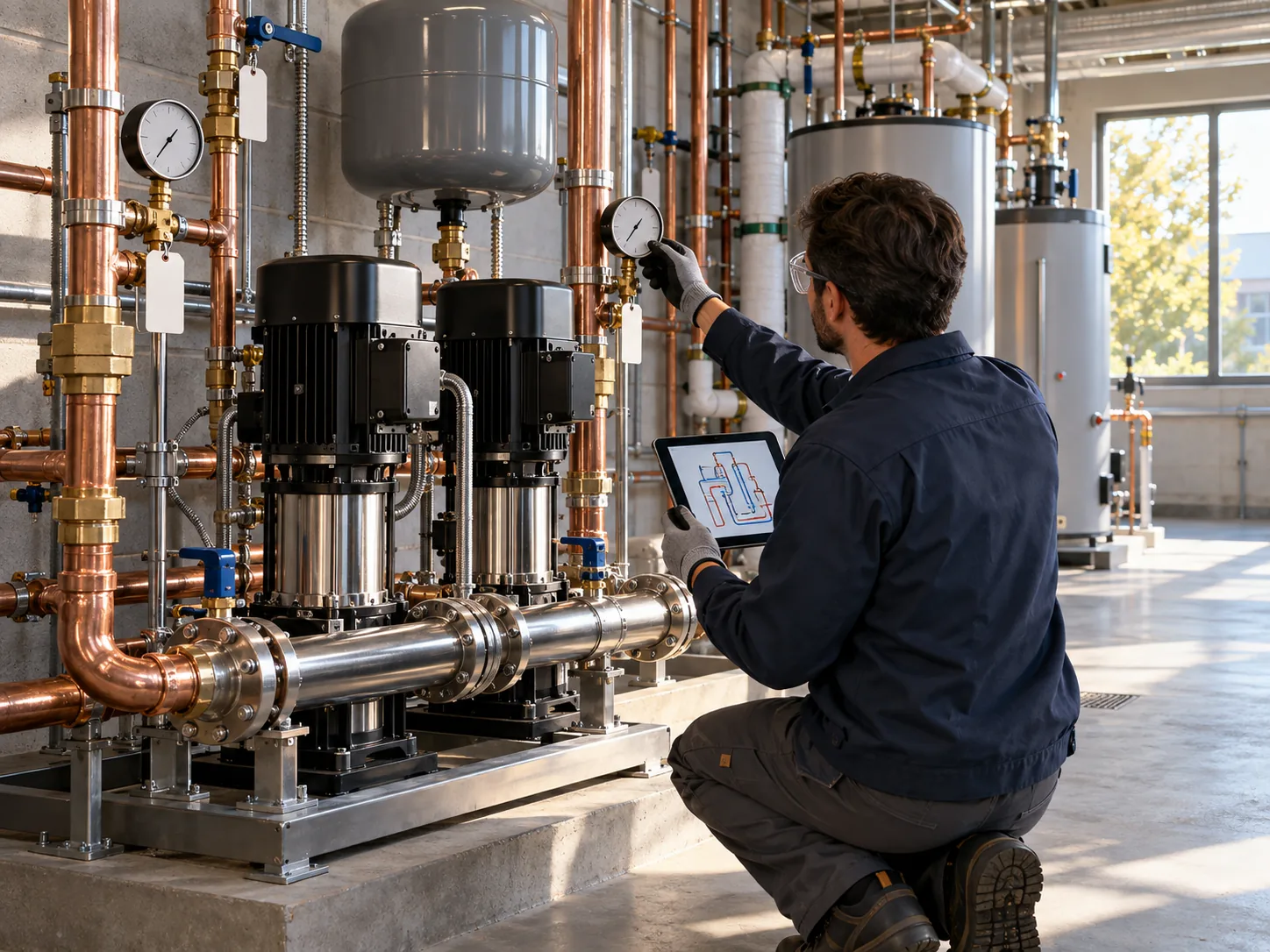
- A fixture unit isn't gallons per minute; it estimates probable demand from how much water a fixture uses and how often.
- Sizing pipe on flow alone, without closing a pressure budget, is how systems end up starved at the top floor.
- With today's low-flow fixtures, Hunter's classic curve tends to over-predict demand, leading to oversized pipe, slower hot-water delivery and stagnation concerns.
Domestic water sizing assigns each fixture a water supply fixture unit (WSFU) value, totals them, and converts that total to a probable peak flow in GPM using Hunter’s curve — which accounts for the fact that not every fixture runs at once. That flow, plus a pressure budget from the meter to the worst-case fixture, is what actually sizes the pipe. Hunter’s curve can over-predict demand with modern low-flow fixtures. For homes and multifamily buildings with water-conserving fixtures, the newer Water Demand Calculator (WDC) is an alternative where the jurisdiction accepts it.
Fixture Units: A Probability System, Not a Flow Measurement
Domestic water sizing starts with water supply fixture units (WSFU). A fixture unit is not gallons per minute; it estimates a fixture’s probable demand based on how much water it uses and how often. That demand becomes the basis for selecting pipe sizes and protecting performance.
The reason the whole system exists is diversity: not every fixture runs at once. If you sized pipe assuming every faucet and flush valve in a building opened simultaneously, you'd wildly oversize everything. Fixture units are a probability-based way to model realistic peak demand instead of worst-case-everything.
The method traces to Dr. Roy B. Hunter at the National Bureau of Standards — his demand curve was published in BMS65 in 1940 — and it's still the backbone of the IPC and UPC sizing provisions today.
Hunter's Curve: From Fixture Units to Gallons Per Minute
Once you've assigned WSFU values to every fixture and summed them for a branch or the whole system, you convert that total to a peak flow in GPM using Hunter's curve (published in the code as a demand-load table), then add continuous demands, such as irrigation and process loads, at their full GPM. The curve is deliberately not linear — it flattens as fixture counts rise, because the more fixtures you have, the less likely they all peak together.
That non-linearity is the whole point. As a rough sense of the shape: a small count like 10 fixture units corresponds to only about 15 GPM on a flush-tank system (27 GPM with flush valves), while several hundred fixture units still land at a demand far below the arithmetic sum of every fixture's flow. You size cold and hot supply from these demands, then pick pipe sizes that hold velocity and friction loss in range per the code tables and the available pressure. Drainage is sized separately, from its own drainage-fixture-unit table — DFU and WSFU are separate values and aren’t interchangeable.
The Eight-Step Arc of a Supply Design
In practice a domestic water design runs about like this: establish available pressure; assign fixture units; total them for cold, hot, and each branch; convert to peak GPM via the demand curve; account for elevation and pressure losses (meter, backflow, fittings); set a velocity limit to control noise and erosion; size the pipe from the code tables; and, where the building is tall or the far run is long, add a booster to close the pressure budget or hot-water recirculation to shorten the wait for hot water, as needed. Miss a step — forget the pressure loss through the backflow preventer, say — and the far fixture pays for it. None of these steps happen once and lock — the pressure assumptions get firmer and the pipe sizes get closer to final as the design itself moves from SD through DD and CD.
The Pressure Budget: From the Meter to the Worst-Case Fixture
Flow tells you how much water; the pressure budget tells you whether it actually arrives. Sizing pipe on flow alone, without closing a pressure budget, is how systems end up starved at the top floor or the far end of a run. The budget starts with the available pressure at the meter — the utility’s documented minimum service pressure, not a best-season flow-test reading — and subtracts everything standing between it and the hardest-to-serve fixture. Meter and backflow-preventer losses come off manufacturer curves at design flow; an RPZ alone commonly costs 10–15 psi.
| Budget line | What it accounts for |
|---|---|
| Static pressure & elevation | Elevation reduces static pressure by roughly 0.43 psi for every foot the fixture sits above the meter — about 4.3 psi per floor at a 10-ft floor-to-floor. Use 0.43 × the actual floor-to-floor height: 12- to 14-ft commercial levels cost 5–6 psi each. |
| Water meter & backflow preventer | Both take a real, sometimes large, pressure hit as water passes through. |
| Friction loss in the pipe | A function of flow, pipe size, and length — coupled directly to the sizing decision itself. |
| Fittings & valves | Every elbow, tee, and valve adds a small loss that accumulates over a long run. |
| Required residual pressure | What has to be left over at the fixture (or flush valve) for it to actually work. IPC Table 604.3 minimum flow pressures: 8 psi at lavatories, sinks and standard showers, 20 psi at tank-type water closets and pressure-balancing or thermostatic shower valves, and, in the 2024 edition, 35 psi for siphonic and 45 psi for blowout flush-valve water closets. The UPC instead sets a 15 psi minimum residual. Check the adopted code table and the manufacturer’s minimum. Static pressure is capped at 80 psi at fixtures, which is what forces PRVs on the low floors. |
Add it all up and compare the total to available pressure. If the budget doesn't close, the fix isn't always bigger pipe — it may be a booster pump, a smarter route, or splitting the building into pressure zones, all covered below.
Velocity: The Quiet Constraint
Pipe can't just be sized for pressure — pipe velocity governs from the other side. Push water too fast and you get noise, water hammer, and, over years, erosion of the pipe interior, especially in copper hot-water lines. Run it too slow — which is exactly what oversized pipe does — and you trade those problems for a different one: water sits too long.
Designers hold velocity within accepted ranges — roughly 8 ft/s on cold, 5 ft/s on hot up to 140 °F, and 2–3 ft/s above 140 °F in copper — lower on hot because hot water accelerates erosion, and that ceiling is often what actually sets the minimum pipe size once flow and pressure are already satisfied. Velocity is the constraint that quietly keeps a system quiet — and it's one more reason "bigger to be safe" is usually wrong.
When Pressure Runs Out: Booster Pumps, PRVs, and Pressure Zones
When the pressure budget won't close — tall buildings, low street pressure, long runs — the design adds equipment rather than just bigger pipe. This is where domestic water design stops being a pipe-size table and becomes a system, and it shows up often on commercial & office high-rises where street pressure alone may not meet top-floor residual-pressure requirements.
| Equipment | What it solves |
|---|---|
| Booster pump | Raises system pressure where the utility can't reach the top floors on its own. Sized to the peak GPM and the pressure deficit; variable-speed booster pumps match output to actual demand instead of running full-speed against a bypass. Use staged or parallel pumps with a low-flow shutdown (and a hydro-pneumatic tank where the control scheme needs one) so the system isn’t deadheading at 2 a.m., base the setpoint on the critical fixture’s required residual plus the elevation and friction losses from the sensing point, and put suction-pressure protection on the controller. |
| Pressure-reducing valve (PRV) | Protects fixtures where pressure is too high — the low floors of a boosted high-rise, or a high-static site — cutting leaks and water hammer. |
| Pressure zone | Splits a tall building into vertical zones so no fixture sees too much or too little, each fed and regulated to a target range. |
| Expansion tank | Absorbs thermal expansion where a check valve, backflow preventer or PRV closes the system. Mounted on the water heater's cold supply, between the heater and the closing device, and sized per the code and the manufacturer's instructions so pressure stays within limits as water heats. |
None of this lives in isolation — it takes the same MEP coordination as everything else on the set: boosters and expansion tanks need mechanical room space and structural support, PRVs need access for service, and pressure zones need to be drawn consistently across the riser diagram from basement to roof.
What's Changing: Hunter's Curve Is Aging
Here's the part that separates a current designer from one running on autopilot. Hunter developed his curve when fixtures used far more water than they do now. Today's low-flow toilets, faucets, and flush valves use a fraction of that, which means the classic curve tends to over-predict demand for modern buildings — leading to oversized pipe, slower hot-water delivery, and stagnation concerns.
The industry response is the Water Demand Calculator, developed through IAPMO/ASPE research and now referenced in code (for example, as Appendix M of the UPC). It uses updated statistical methods and real modern fixture flow rates to estimate peak demand for single- and multifamily dwellings with water-conserving fixtures. It isn't universally adopted yet, and jurisdictions vary — but knowing when the traditional curve oversizes, and when a modern method is accepted, is exactly the judgment that keeps a system right-sized. Confirm which sizing method your jurisdiction accepts before you rely on it.
Water Age: The Modern Reason Not to Oversize
Here's the argument that makes this whole topic current. Old habits oversized pipe "to be safe." But low-flow fixtures mean less water moves through the same pipe, so oversized pipe today just means water sits longer. That rising water age is a water-quality problem, not just an efficiency one: disinfectant residual decays over time, and stagnant water sitting in oversized mains and dead legs is exactly the condition associated with Legionella growth. It's a particularly sharp concern on healthcare & medical projects, where immunocompromised occupants make water-quality margin non-negotiable.
So the modern driver to right-size — not upsize — domestic water isn't just cost or velocity, it's water quality. It's why the Water Demand Calculator, which reflects low-flow reality better than Hunter's curve, matters beyond academic accuracy: sizing closer to real demand keeps water fresher. Minimizing dead legs, sizing recirculation properly, and skipping the old "oversize for safety" habit are health decisions now, not just efficiency ones.
Hot-Water Recirculation, and Walking an Apartment Stack
Recirculation keeps hot water moving in a loop near the fixtures, so the wait for hot water at the far end is shorter, though uncirculated branches still hold cooled water that has to run out first. A recirculation pump is sized from the loop's heat loss and allowed temperature drop (for flow) and the loop's friction loss (for head), not fixture demand, and the branches are balanced so each gets flow. It interacts directly with water age too — a well-designed loop keeps water moving and hot, while a dead-legged one invites stagnation.
Walking an apartment stack: total the WSFU for the units on the stack, convert to a peak GPM using Hunter's curve (or, where the jurisdiction accepts it for a residential building, enter the fixture counts and flow rates into the Water Demand Calculator), then build the pressure budget from the meter up the stack — elevation and static pressure loss, the meter and backflow preventer, friction loss, and fitting losses. Size the pipe to satisfy flow, velocity, and the residual pressure needed at the top unit. If the budget doesn't close at the top floor, that's your booster-pump trigger, found on paper against the riser diagram — not after a tenant on a multifamily project complains about a weak top-floor shower.
How CoreX Handles It
We size domestic water to a defensible demand, not a habit. Fixture units assigned per the adopted code, converted through the correct demand method, with pressure losses and velocity limits actually accounted for — and where a project's fixtures and jurisdiction make the traditional curve oversize, we evaluate whether a modern method like the Water Demand Calculator applies. The result is piping sized to deliver peak demand without the oversizing that slows hot water and wastes it. On multifamily especially, that's the difference between a system designed to meet each floor's requirements and one vulnerable to top-floor pressure complaints.
Related: DWV Sizing (Drainage Fixture Units, Slope & Venting) · MEP Coordination Best Practices · How to Read MEP Drawings
If your plumbing production needs domestic water sizing support, we prepare it under your engineer of record’s direction and seal. See our plumbing services and Residential & Multi-Family, or schedule a scope call.
Common Questions
A water supply fixture unit (WSFU) isn’t a flow measurement — it’s a design factor representing the probable load a fixture places on the system, based on how much water it uses and how often. Fixture units let designers model realistic peak demand instead of assuming every fixture runs at once.
Once fixture units are totaled for a branch or system, Hunter’s curve (published in the code as a demand-load table) converts that total into a peak flow in gallons per minute. The curve flattens as fixture counts rise, because the more fixtures a system has, the less likely they all peak together — and that demand is what sizes the pipe.
For low-flow residential and multifamily buildings, yes — that is the scope the method was validated and code-referenced for. Hunter’s curve predates today’s low-flow fixtures and can over-predict demand, leading to oversized pipe and slower hot-water delivery. The Water Demand Calculator uses updated statistical methods and real modern fixture flow rates, and it’s gaining code recognition — but it isn’t universally adopted, so confirm which method your jurisdiction accepts.
Most often in buildings with low-flow fixtures. Because Hunter’s curve was calibrated on older, higher-flow fixtures, it can over-predict peak demand in buildings built around today’s low-flow toilets, faucets, and flush valves, which can lead to oversized pipe.
Available pressure is the water pressure on hand at the meter or service entrance to the building. A pressure budget subtracts every loss between the meter and the worst-case fixture — elevation, the meter and backflow preventer, friction loss, and fittings — from that available pressure, and compares what’s left to the residual pressure the fixture actually needs.
By summing static pressure loss from elevation, the loss through the water meter and backflow preventer, friction loss in the pipe itself (a function of flow, pipe size, and length), and losses through fittings and valves, then comparing the total against available pressure at the meter.
When available pressure can’t meet the residual pressure needed at the highest or farthest fixture once every loss in the pressure budget is accounted for — common in high-rises and on services with low street pressure.
Design velocities are held within accepted ranges, typically a bit lower on hot water than cold because hot water accelerates erosion, to avoid noise, water hammer, and pipe erosion. That velocity ceiling often ends up setting the minimum pipe size once flow and pressure are already satisfied.
They cost more in material, and because low-flow fixtures move less water through the same pipe, oversized pipe raises water age — letting disinfectant residual decay and creating the stagnation associated with Legionella growth.
Usually a fixture far from the water heater with no recirculation loop, or a poorly balanced one, so it runs cold water down the drain before hot water arrives. A properly sized and balanced recirculation loop shortens the wait, though long uncirculated branches still add delay.
A pressure-reducing valve, used where pressure is too high — the low floors of a boosted high-rise, or a high-static site — to protect fixtures and reduce leaks and water hammer.

Senior electrical designer with 6+ years in U.S. MEP design, contributor to 900+ projects, and an experienced third-party peer and plan reviewer.
Connect on LinkedIn →