EV Charging Infrastructure: Load, Service & Code Readiness
How EV charging is sized and documented under NEC Articles 625 and 220: continuous loads, energy management, service capacity, and the EV-ready rules that set how many chargers a project needs.
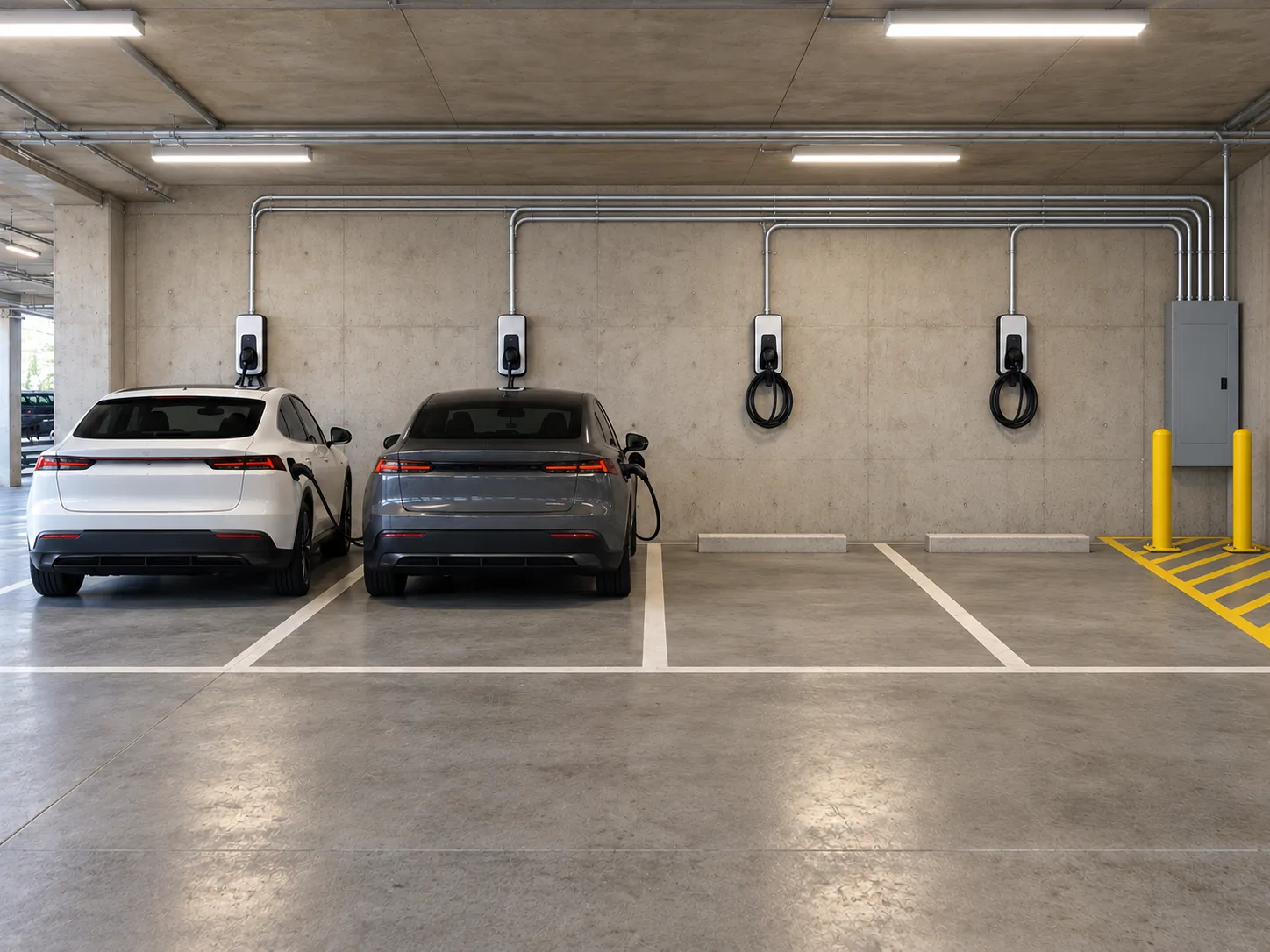
- EV charging is a continuous load at 125%; the 2023 NEC standard calculation counts each charger at 7,200 VA or nameplate, whichever is larger (625.41, 220.57).
- An energy management system can cap the EV load used to size the service and feeder, often avoiding a service upgrade.
- The number of chargers comes from the adopted energy or green code, not the NEC; confirm it with the jurisdiction and the utility early.
EV charging is sized in three steps: count, load and capacity. The count comes from the jurisdiction (how many spaces must be EV-capable, EV-ready or have chargers installed). The load comes from NEC Articles 625 and 220: each charger is a continuous load at 125 percent, counted at 7,200 VA or its nameplate rating, whichever is larger, under the 2023 NEC unless a load management system limits it. The capacity check asks whether the existing service and the utility transformer can carry that load, with or without load management, and the utility has to confirm it.
EV charging has moved from an owner's option to a code requirement on many projects, and it can be one of the largest single loads on a commercial or multifamily service. A row of Level 2 chargers can add hundreds of amperes; a few DC fast chargers can exceed the spare capacity of the building's service. Most of the design work is deciding how much of that load the service really has to carry, and documenting it so the building department and the utility agree.
Section numbers below are from the 2023 National Electrical Code (NFPA 70), which many states enforce today, including California through the 2025 California Electrical Code. A growing number of states have adopted the 2026 NEC, which renumbers the load-calculation rules and changes some of them; a later section covers what moves. Always confirm the edition and local amendments your jurisdiction enforces.
Level 2 vs. DC Fast: What You Are Designing For
Level 2 charging runs on 208 V (typical commercial) or 240 V (typical residential) AC and delivers roughly 2.9 to 19.2 kW per unit, according to the U.S. Department of Energy's Alternative Fuels Data Center. It covers most workplace, multifamily, hotel and retail parking, where vehicles stay for hours.
DC fast charging typically takes a three-phase AC input and converts it to DC inside the charger, with units up to 500 kW. It suits fleet depots, highway sites and retail stops measured in minutes. A handful of DC fast chargers can need a new service or a utility transformer of their own, and the DOE notes they are more likely than Level 2 to trigger utility demand charges.
The mix of Level 2 and DC fast, and how many of each, should be settled with the owner before the electrical design starts, because it decides whether the project is a branch-circuit exercise or a service-and-utility project.
NEC 625: Circuits, Protection & Disconnects
Article 625 governs electric vehicle power transfer systems. The rules that shape most designs:
- Individual branch circuits. Each outlet for EVSE rated more than 16 amperes or 120 volts is supplied by an individual branch circuit, except that one circuit may feed several EVSE under load management as permitted by 625.42 (625.40).
- Continuous load at 125 percent. EV charging loads are continuous (625.42), and the overcurrent protection for feeders and branch circuits supplying EVSE is sized at not less than 125 percent of the equipment's maximum load (625.41). A charger rated 32 A needs a 40 A circuit; one rated 48 A needs 60 A.
- Disconnecting means. EVSE rated more than 60 amperes or more than 150 volts to ground needs a readily accessible disconnecting means, lockable in the open position; if it is remote from the equipment, a plaque on the equipment shows where it is (625.43).
- GFCI and personnel protection. All receptacles installed for EV charging need GFCI protection for personnel (625.54), and EVSE itself must have a listed personnel protection system (625.22).
- Location and ventilation. Unless listed otherwise, the coupling means is stored at least 18 in. above the floor indoors or 24 in. above grade outdoors (625.50). Mechanical ventilation for indoor charging is required only where the equipment is listed as requiring it (625.52); it is not required for equipment listed for indoor charging without ventilation.
The Load Calculation (Article 220)
For the standard service and feeder calculation, the 2023 NEC sets a floor: each EVSE is calculated at 7,200 VA or its nameplate rating, whichever is larger (220.57). Two other rules follow from it:
- The 75 percent demand factor that Article 220 allows for four or more fastened-in-place appliances in dwellings does not apply to EVSE (220.53).
- Because the load is continuous, EVSE feeder and branch-circuit overcurrent protection is sized at 125 percent (625.41), and service and feeder conductors normally carry it at 125 percent as well, unless the exception for a 100-percent-rated assembly applies.
An illustrative example: eighteen Level 2 chargers rated 32 A at 208 V single-phase have a nameplate of 6,656 VA each, so each is counted at 7,200 VA. Eighteen of them total 129.6 kVA; at 125 percent that is 162 kVA, about 450 A on a 208Y/120 V three-phase service with six chargers on each phase pair. That is often more spare capacity than an existing building has, which is why the next section matters. (Real projects add the rest of the building load, use the actual equipment ratings and check voltage drop on the longer runs.)
Where a project adds chargers to an existing building, NEC 220.87 allows the existing load to be taken from measured maximum demand: a year of demand data or, under its exception, at least 30 days of continuously recorded 15-minute demand on the highest-loaded phase, taken while the building is occupied and including the larger of the heating or cooling load and other seasonal loads. The exception is not permitted where the feeder or service has solar or wind generation or any peak load shaving. Either way, the maximum demand at 125 percent plus the new load has to stay within the feeder ampacity or service rating. See Electrical Service Load Calculations: NEC 220 for the full method.
Load Management: EMS & Adjustable Settings
The NEC does not force a design to assume every charger draws its full rating at once, provided something enforces the limit. Two mechanisms are recognized:
- Energy management systems (EMS). Where an EMS complying with 750.30 provides load management of EVSE, the maximum equipment load on a service and feeder is the maximum load the EMS permits (625.42(A)). For the load calculation, a single value equal to the EMS's maximum ampere setpoint may be used, and that setpoint is treated as a continuous load (220.70).
- EVSE with restricted adjustable settings. EVSE with restricted access to its ampere-adjusting means (750.30(C)) may be counted at the adjusted rating shown on its label (625.42(B)).
In the example above, an EMS set at 200 A on the EV feeder would be counted as a 200 A continuous load, so the feeder and its protection are sized for 250 A instead of about 450 A. The trade-off is charging speed at peak: the chargers share the setpoint, so the owner has to accept slower or paused charging per vehicle when many are plugged in at once. That is an owner decision to record, within any minimum charging rate the adopted EV code sets (CALGreen requires one), not an engineering default.
Service Capacity & the Utility
The capacity question has two halves. The building side asks whether the existing service, switchboard and feeders have the room, which is answered from the record drawings, the panel schedules and metered demand data. The utility side asks whether the utility's transformer and service lateral can carry the new load, and only the utility can answer that. The DOE advises engaging the utility early in EV infrastructure planning, and a DOE cost study found that sites with DC fast chargers or many Level 2 chargers are more likely to need a service upgrade.
A practical sequence: establish the existing peak demand, calculate the EV load with and without load management, prepare the load letter or service application the utility asks for, and design make-ready conduit, space and service capacity for the chargers the owner plans to add later, so the next phase does not reopen the service.
How Many Chargers: EV-Ready Codes
The NEC tells you how to wire chargers, not how many to provide. The count comes from the jurisdiction's energy or green building code and local ordinances, which typically use three levels of readiness:
- EV-capable: electrical capacity and raceway reserved for a future charger.
- EV-ready: a complete branch circuit ending in a receptacle or junction box at the space.
- EVSE-installed: the charger itself is installed.
The 2024 IECC places its EV provisions in appendices (Appendix CG for commercial buildings, Appendix RE for residential), which apply only where a jurisdiction adopts them. As an example of scale, the commercial appendix asks Group B (business) occupancies for EVSE at 15 percent of parking spaces plus EV-capable spaces at 30 percent. California's CALGreen sets its own mandatory counts; in the 2025 edition each nonresidential EV-capable space needs capacity for a dedicated 208/240 V, 40 A branch circuit, and each DC fast charger installed can reduce the required number of EV-capable spaces without EVSE or Level 2 charging stations by five, with a proportional reduction in the required electrical load capacity. Many cities layer their own ordinances on top, so the requirement is confirmed per project.
Accessible Charging Spaces
The federal ADA Standards do not yet set a number of accessible EV charging spaces; existing ADA requirements for accessible routes, clear floor space, reach ranges and operable parts still apply, and the U.S. Access Board has published EV-specific recommendations as non-binding technical assistance. California does mandate them: the California Building Code (11B-228.3) requires, for public- and common-use charging spaces, one van-accessible space where a facility has one to four charging spaces and one van-accessible plus one standard accessible space for five to twenty-five, with each combination of charging level and connector type counted as a separate facility. Accessible spaces need a larger stall and an access aisle, so they are located with the architect and civil engineer, and the electrical design follows the chosen stalls.
What Changes in the 2026 NEC
Jurisdictions on the 2026 NEC (a growing group that includes Massachusetts, Minnesota, Texas, Colorado and Oregon) will see changes that affect EV design:
- Renumbering. The load-calculation rules move from Article 220 to a new Article 120, so 220.57 becomes 120.57.
- The EVSE load rule. The 2026 edition revises the 7,200 VA rule so the equipment's nameplate rating is used where it is available, with 7,200 VA as the fallback, and adds EVSE explicitly to the optional dwelling calculation.
- Power control systems. Energy management system requirements move from Article 750 to a new Article 130, and a new 120.7 permits the service and feeder calculation to use the setting of a power control system (PCS) that limits the load.
- Disconnects. 625.43 is expanded, including an emergency shutoff requirement for permanently connected EVSE at other than one- and two-family dwellings. A proposed Tentative Interim Amendment to it (TIA 1874) was not issued by the NFPA Standards Council in April 2026, so the published text stands.
The method is the same; the section numbers, the EVSE load value and the disconnect requirements follow the edition the jurisdiction has adopted.
What a Reviewer Checks
- A charger schedule with each unit's voltage, phase, nameplate rating and the breaker size at 125 percent.
- The load calculation listing EVSE at 7,200 VA or nameplate (2023 NEC), or at the EMS setpoint where load management is used, with the EMS or adjustable-setting basis documented.
- The one-line diagram and panel schedules agreeing with the calculation.
- Disconnects, GFCI protection and equipment locations per Article 625.
- Available fault current at new and affected equipment, checked against interrupting and short-circuit current ratings, with the 110.24 service marking updated where it changes.
- The count table showing EV-capable, EV-ready and EVSE-installed spaces against the adopted code or ordinance, and the accessible spaces where required.
- Utility confirmation of service capacity where the load increases.
Further reading: Electrical Service Load Calculations: NEC 220 · Short-Circuit, Coordination & Arc-Flash Studies · MEP for Multifamily
Your engineer of record stays in responsible charge, directing the design decisions, reviewing and sealing. CoreX prepares the EV charging production work: the capacity assessment from your record drawings and utility data, charger branch circuits and load management, make-ready pathways for future phases and the load documentation the utility needs under that direction. Code references in this article are general guidance, so confirm the requirements for your project with your AHJ and engineer of record. See our electrical services and automotive and EV work, or schedule a scope call.
Common Questions
Under the 2023 NEC standard calculation, each EVSE is calculated at 7,200 VA or its nameplate rating, whichever is larger (220.57). It is a continuous load, so it is normally carried at 125 percent (a 100-percent-rated service assembly can be an exception), and the 75 percent dwelling appliance demand factor does not apply to it (220.53). Where an energy management system limits the load, its maximum setpoint may be used instead (220.70, 625.42).
A 60 A breaker. EV charging is a continuous load, and NEC 625.41 requires the overcurrent protection to be rated at not less than 125 percent of the equipment’s maximum load (48 A × 1.25 = 60 A).
All receptacles installed for EV charging need GFCI protection for personnel (NEC 625.54). EVSE itself, whether hard-wired or cord-and-plug connected, must have a listed personnel protection system (625.22).
When the EVSE is rated more than 60 amperes or more than 150 volts to ground. The disconnecting means must be readily accessible and lockable open, with a plaque on the equipment if it is remote (NEC 625.43).
An EV-capable space has electrical capacity and raceway reserved for a future charger. An EV-ready space has a complete branch circuit ending in a receptacle or junction box. An EVSE-installed space has the charger in place. The required number of each comes from the adopted energy or green code and local ordinances.
It can. Where an energy management system controls the chargers, the NEC lets the service and feeder be sized for the EMS setpoint rather than every charger at full rating (625.42(A), 220.70). Charging slows at peak because the chargers share the limit, and the utility still has to confirm its side of the service.

Senior electrical designer with 6+ years in U.S. MEP design, contributor to 900+ projects, and an experienced third-party peer and plan reviewer.
Connect on LinkedIn →